


If you've been watching the Denver metro real estate market lately, you've probably noticed the mood has shifted. Spring is here, but the energy feels a little different than past years — and the numbers are starting to tell that story clearly.
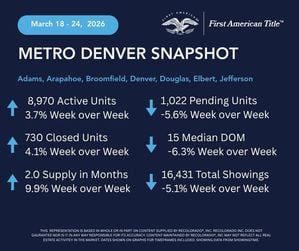
Every week, Megan Aller at First American Title puts out one of the most useful market snapshots in the business. Here's our take on what her latest data — covering March 18–24, 2026 across Adams, Arapahoe, Broomfield, Denver, Douglas, Elbert, and Jefferson Counties — means for buyers and sellers in the Denver metro right now.
What the Numbers Are Saying
Let's start with inventory. There are currently 8,970 active units on the market — up 3.7% week over week. That might sound modest, but when you're watching the market weekly, nearly 4% in a single week is a meaningful move. More homes are hitting the market just as buyer activity is softening.
Pending sales — homes that went under contract — came in at 1,022 units, down 5.6% from the prior week. Showings followed the same pattern, dropping to 16,431 total — a 5.1% decline. Fewer buyers are walking through doors and fewer are pulling the trigger.
On the positive side, 730 homes closed last week, up 4.1% — a sign that the buyers who are engaged are still moving forward. And the median days on market sits at just 15 days, actually down 6.3% from the week prior. So well-priced, well-presented homes are still selling quickly.
Supply ticked up to 2.0 months — nearly a 10% jump in a week. We're still technically in seller's market territory (anything under 3–4 months generally favors sellers), but the direction of travel matters as much as the number itself.
Why Buyers Are Pumping the Brakes
A few things are happening at once. Spring Break is pulling families away from home searches for several weeks across different school districts. Global headlines and economic uncertainty are creating hesitation. And interest rates — after showing some promise earlier this year — have crept back up, which directly affects what buyers can afford each month.
When monthly payments increase, buyers recalculate. Some pause. Some shrink their price range. And some simply wait to see what happens — which is exactly what the showing and pending data is reflecting right now.
What This Means If You're Selling
Here's the part sellers need to hear: the best window we saw in the Denver metro this year was late February. Since then, demand has been gradually softening as rates climbed. That doesn't mean it's a bad time to sell — it means precision matters more than it did two months ago.
Right now, buyers have more choices than they did earlier this year. When they have options, they move past homes that feel overpriced — they don't negotiate them down. The listings generating strong activity are the ones that are priced accurately from day one, show-ready, and marketed aggressively to reach the widest possible buyer pool.
There's also a concessions trend worth watching. As rates rise, more buyers are asking sellers to help offset their monthly payment through closing cost assistance or rate buydowns. Sellers who understand this going in are in a much better position than those who are caught off guard mid-negotiation. Your net sheet should reflect today's reality, not last year's.
You may have seen a national article recently naming April 12th as the best week to sell. That data is national — and national averages rarely reflect what's happening in specific local markets. Here in metro Denver, our data tells a different story. Local matters. Neighborhood-level data matters even more.
What This Means If You're Buying
If you've been sitting on the sidelines, the current environment has some silver linings. You have more inventory to choose from than you did even a month ago. Sellers are increasingly open to concessions. And homes that are lingering on market — particularly those with overambitious pricing — may represent real opportunities for buyers willing to engage.
The challenge, of course, is that rates have made affordability tighter. Working with a strong lender who can structure your loan creatively — including buydown options — can make a meaningful difference in your monthly payment and your ability to compete.
The Bottom Line
The Denver metro market isn't falling apart — but it's not the same market it was at the start of the year either. Inventory is growing, buyer urgency is easing, and rate sensitivity is shaping nearly every transaction. Whether you're buying or selling in Jefferson County, the foothills communities, or anywhere across the metro, the difference between a smooth transaction and a frustrating one often comes down to one thing: working with people who are watching this data every single week and translating it into a strategy that actually fits your situation.
Market data sourced from the weekly Metro Denver Snapshot by Megan Aller, First American Title, covering March 18–24, 2026. Data based in whole or in part on content supplied by REColorado®, Inc. Showing data from ShowingTime.
Let's Talk About Your Situation
Whether you're thinking about selling your home in Morrison, Evergreen, Littleton, or anywhere across the Denver metro — or you're a buyer trying to figure out your next move — we'd love to have a straight conversation about what the market means for you specifically.
📞 Call or text us at (720) 314-8462 📧 [email protected] 📅 Grab a time that works: calendly.com/tim-jonesteam/15min
— Tim & Sandy Jones | Jones Team Colorado with eXp Realty
Check out this article next